Author's Note
This writing project proved to be more difficult than I originally thought. Upon researching and learning more about actual comics and their properties, I began to realize that there are many aspects of comics that had failed to register in my eyes. When picking a comic, I opted for a more serious one that also happened to not be an animation of something. I felt drawn to this particular comic because of the message it is getting across because it's something I've been working with as part of my way of thinking for a large part of my life. I also like the way photography is used as a background in the A Softer World Comics and found the other comics to be thought provoking and entertaining.
My first draft was not as organized due to the fact that I had not quite sorted out in my head what I wanted to focus on primarily and how to best organize it. I originally planned on discussing each panel individually, one section about framing and one about logos through word choice and then wrapping up with time progression. However the first peer review provided me with a better idea of discussing each element one section at a time but further dividing that up into sections about each paragraph.
My second draft attempted to do this but I was able to develop it even better in the final draft. For example, in my introduction I state "the comic employs the rhetorical appeal of logos through the word choice, the technical element of framing, and the appeal to pathos in the representation of time progression" in an order that I felt best explained the importance of each element. When I began discussing the logos through word choice, I followed the order of the panels to make the most logical sense. I elaborated on the third panel and discussed how word choice was further implemented in this panel.
In my section about framing, I feel I was more specific about how framing in each panel functioned as a focusing tool. For example, I state that "similarly, the third panel is framed that it only shows one object next to the words. As in panel two, this brings the focus to the words." This was important to what I was writing because I was trying to emphasize the relationship that persists over the progression of all of the panels.
In my revisions for the final draft, I also rethought exactly what I was trying to get across about the element of time progression throught the comic. I feel I better pinpointed this when I clarified that "The aspects of word choice and framing that are developed through the comic work together to create the representation of time progression, which in itself is an appeal to both logos and pathos." Throughout that paragraph I try to explain that this is what all the elements I had previously discussed are culminating to and working together to create throughout the comic.
As for the technical aspects of my essay, I improved the aesthetic of the photgraphs by figuring out that my laptop does not let me resize the pictures for some reason and fixed this. I also fixed the problem that some of my paragraphs were unevenly spaced and some of the font became ghosted by typing the entire final draft in the Edit Html mode using the basic html functions that my father showed me how to do shortly before I finished this final draft of writing project 2.
Rough Draft 2
Rough Draft 1
Statement of Purpose
Writing Project 2
Traveling carnivals are a part of an American summer tradition that many people are familiar  with. The modern carnival has undergone evolutions and transformations since the debut of the amusement park at the Chicago World's Fair of 1893 (Amusement Parks). The first traveling carnivals developed a bad reputation because of the shady nature of many of their workers, the exhibits themselves, and the nature of society at the time to judge what was not up to certain standards (Traveling Carnivals). However, after the first Chicago World's Fair that introduced amusement park rides, carnivals began to change. They started to drop the less delightful aspects of freak shows and other adverse exhibits and added more fun rides from the amusement parks. This has developed to the common traveling carnival of today that evokes the feeling of letting go and enjoying the moment with adrenaline-rush inducing rides, deep fried foods, and arcade games that have a limited chance of winning but you do it anyways.

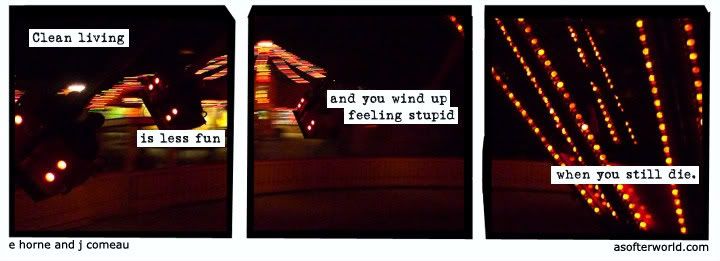
The associations of these feelings with carnival attractions are thus elicited when viewing images of such rides. The comic "I've been waiting," from the A Softer World collection by Emily Horne and Joey Comeau, uses this image paired with the statement "clean living is less fun and you wind up feeling stupid when you still die." The comic is commenting on the fact that life ends no matter what route one takes and it should be enjoyed. This is most effectively brought about by the relationship between the image of the carnival ride as the background and the words that are spread across the panels. To establish this relationship, the comic employs the rhetorical appeal of logos through the word choice, the technical element of framing, and the appeal to pathos in the representation of time progression that is developed through the aforementioned two. It is important to investigate each panel individually and then explore their final congruence in the same manner as one reads a comic.
In accordance with this separation of the photograph that contains certain representations for each panel, there is a separation of the words across the comic. As with the aspect of observing each panel separately, the observer of the comic also reads each statement on its own and processes it that way, and then evaluates the entire sentence at the end. The first panel contains the statement "clean living is less fun" that is itself split in half at the top and bottom of panel which are processed by the reader individually as well. The reader begins by developing what clean living means to them by examples in their own life or what they see in other people's lives. This may have a positive connotation at first because most people don't want to live a dirty or polluted life. However, the next statement to be processed, that it is less fun, changes the tone to the reader. They begin to rethink what clean living means and why it isn't always a good idea. This is an appeal to logos because of the way it changes the cognition of the reader.
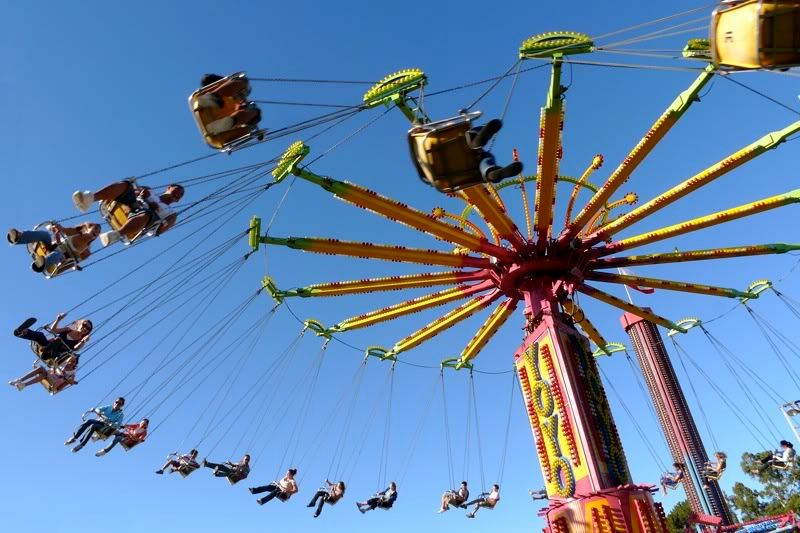
 The second panel further employs logos to change the cognition of the reader. The writing is not separated within the panel like the first one. The reader processes the statement in its whole which is further pushing the idea that clean living is not as good of an idea as originally thought. The word choice is important in this statement because of the appeal to logos in the form of word play and because of further change in tone. The words 'wind up' are a play on words referring to not only the image in the background but also due to the nature of life. The image is of a carnival ride that is known as the Yo-Yo and the rider sits in a cart that is spun slowly around the center spindle until centrifugal force brings them almost parallel to the ground and then slowly back to the original position. The rider simply goes in a circle and doesn't actually get anywhere in the sense that they return to the same place except with an altered equilibrium. With the word play on 'wind up' the comic is thus implying that with clean living, one lives life without getting anywhere but returning with an altered state of mind, that of stupidity. Using this word drastically alters the tone of the comic because of its harsh nature that is incongruous with the beginning vocabulary. This is an appeal to logos because of the jolt it gives the reader that continues to alter their belief about clean living that they develop upon reading the very first statement.
The third panel is the conclusion to the comic which is made evident obviously because there are no more panel, but more significantly due to the finality of the words in this panel. The word choice in this panel evokes the feeling of inevitability because of the word 'still.' This word has almost a frustrating connotation because no matter what the circumstances or how hard one tries in life, there will always be that still. The word 'die' is also important because it is a blatant and harsh way of stating that someones life has ended. This alters the tone of the comic to that of conclusiveness but not resolution because the life was not led as it should have been; in the words of the comic it was lived cleanly.
The photograph is framed in such a way that places two carts that are a part of the ride at the focus of the first panel. This is the most obvious indicator that the photograph is indeed of a carnival ride because of objects in the background to place it in context. This is important as a focus because it is the first representation of a carnival ride to the reader. The fact that there are people in the photograph riding the rides is significant because it gives the reader something, or someone, to relate to and begins to lead the reader to the concept that it is okay to have fun. The pairing of this statement is what primes the reader of the comic to this notion of unclean living and enjoying life.
The second panel is framed in such a way that only shows a ride cart that is partially covered up by the words in the panel and not much else is present in the panel. This brings the focus directly to the words in that particular panel while still keeping the image of the carnival ride in sight and mind. The framing of this particular panel also shows part of the fence that is curved that surrounds the ride which references the circular theme present in the 'wind up' statement in the panel. Also, the framing provides space that enables all the writing to fit together in one space and the lack of other objects that would possibly distract the reader brings the focus to the statement in the panel. This is necessary for the change in tone and for the argument that was mentioned previously.
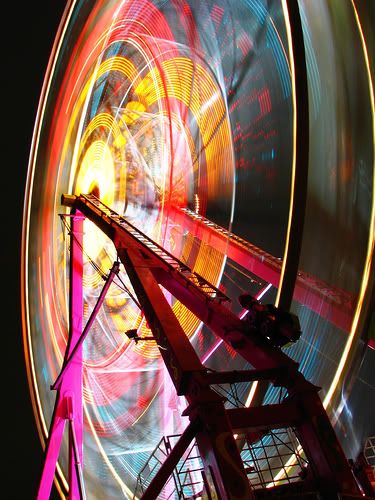
Similarly, the third panel is framed that it only shows one object next to the words. As in panel two, this brings the focus to the words which in this panel are bringing the comic and the argument to a conclusion. However, the object in this case is bright and highly noticeable because it is serving the purpose of representation of the fun and attractiveness of a carnival which is contrast to the final statement
 The aspects of word choice and framing that are developed through the comic work together to create the representation of time progression, which in itself is an appeal to both logos and pathos. This is central to the argument that the relationship between the images and words creates. Time progression is most obviously visually displayed in the comic in the motion that is present in the photograph. The photograph seems to be taken by a person who is riding the carnival ride. The lights on the other ride carts and on the center spindle are clear and distinguishable while the lights of the other ride are blurry and are the point of reference that tells the observer the ride is moving. This motion is continuous across the comic due to the framing of the photograph because although each panel is separated, the reader is able to tell that the photo continues on behind the separation. Likewise, the flow and meaning of the words, while processed individually and then as a whole by the reader, enhance the feeling of continuation and progression beyond the white space of separation. The word choice that is developed as the appeal to logos creates the feeling of the circular nature of life and the inevitable end of time physically through death which itself is expressed in a flowing manner in the comic. As an appeal to logos, it evokes a feeling in the reader which means it is also an appeal to pathos
The relationship of the image and the words in this comic is the most important feature that pushes the argument developed by the rhetorical aspect of logos through word choice, the technical aspect of framing, and the element of time progression that is enhanced by these aspects and that of motion. The comic argues that life ends in the same place no matter how one gets there and it is therefore meant to be taken pleasure from. The pairing of the carnival ride image is part of the argument that evokes a more specific feeling of what 'unclean' living can be. While it is impossible to constantly live one's life in a carnival, figuratively or literally, the comic makes the reader reevaluate how unsoiled they live their life and brings about the question, why do I consider certain things to be important and serious to me if I am just going to die sometime anyways?
Works Cited:
Michael Baers "Traveling Carnivals". St. James Encyclopedia of Pop Culture. Find Articles.com. 21 Mar, 2010. http://findarticles.com/p/articles/mi_g1epc/is_tov/ai_2419101246/
Stan Barker "Amusement Parks". Encyclopedia of Chicago. Encyclopedia.ChicagoHistory.org. 21 Mar, 2010. http://encyclopedia.chicagohistory.org/pages/48.html