Wednesday, March 31, 2010

WP2: Rough Draft 2

Traveling carnivals are a part of an American summer tradition that many people are familiar with. The modern carnival has undergone evolutions and transformations since the debut of the amusement park at the Chicago World’s Fair of 1893 (Amusement Parks). The first traveling carnivals developed a bad reputation because of the shady nature of many of their workers, the exhibits themselves, and the nature of society at the time to judge what was not up to certain standards (Traveling Carnivals). However, after the first Chicago World's Fair that introduced amusement park rides, carnivals began to change. They started to drop the less delightful aspects of freak shows and other adverse exhibits and added more fun rides from the amusement parks. This has developed to the common traveling carnival of today that evokes the feeling of letting go and enjoying the moment with adrenaline-rush inducing rides, deep fried food and arcade games that have a limited chance of winning but you do it anyways.

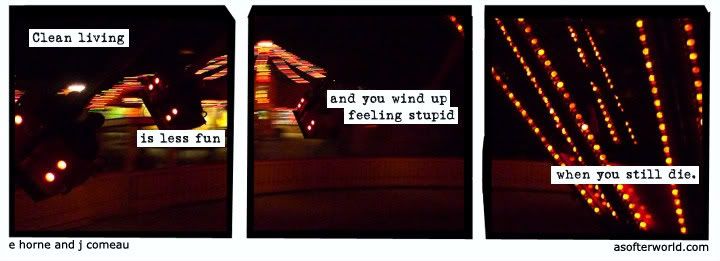
The associations of these feelings with carnival attractions are thus elicited when viewing images of such rides. The comic “I’ve been waiting,” from the A Softer World collection by Emily Horne and Joey Comeau, uses this image paired with the statement “clean living is less fun and you wind up feeling stupid when you still die. The comic is commenting on the fact that life ends no matter what route one takes and it should be enjoyed. This is most effectively brought about by the relationship between the image of the carnival ride as the background and the words that are spread across the panels. To establish this relationship, the comic employs the technical element of framing, the rhetorical appeal of logos through the word choice, and the representation of time progression that is developed through the aforementioned two. It is important to investigate each panel individually and then explore their final congruence in the same manner as one reads a comic.

In accordance with this separation of the photograph that contains certain representations for each panel, there is a separation of the words across the comic. As with the aspect of observing each panel separately, the observer of the comic also reads each statement on its own and processes it that way, and then evaluates the entire sentence at the end. The first panel contains the statement “clean living is less fun” that is itself split in half with the first half at the top of the panel and the second half at the bottom of the panel which are processed by the reader individually as well. The reader begins by developing what clean living means to them by examples in their own life or what they see in other people’s lives. This may have a positive connotation at first because most people don’t want to live a dirty or polluted life. However, the next statement to be processed is that it is less fun changes the tone to the reader. They begin to rethink what clean living means and why it isn’t always a good idea. This is an appeal to logos because of the way it changes the cognition of the reader.

The photograph is framed in such a way that places two carts that are a part of the ride at the focus of the first panel. This is the most obvious indicator that the photograph is of a carnival ride because of objects in the background to place it in context. This is important as a focus because it is the first representation of a carnival ride to the reader. The fact that there are people in the photograph riding the ride is significant because it gives the reader, or rather someone, to relate to and begins to lead the reader to the concept that it is okay to have fun. The pairing of this statement with the image of the two ride carts is what primes the reader of the comic to this notion of unclean living and enjoying life.

The third panel shows a cart that is partially covered up by the words in the panel and not much else is present in the photograph. This brings the focus on the words in that particular panel while still keeping the image of the carnival ride in sight and mind. The framing of this particular panel also shows part of the fence that is curved that surrounds the ride which references the circular theme present in the words in the panel. Also, the framing of the panel provides a space for all of the writing to fit together in one space and the lack of many objects that would possible distract the reader brings the focus to the statement in this panel which is necessary for the change in tone and for the argument that was mentioned previously.
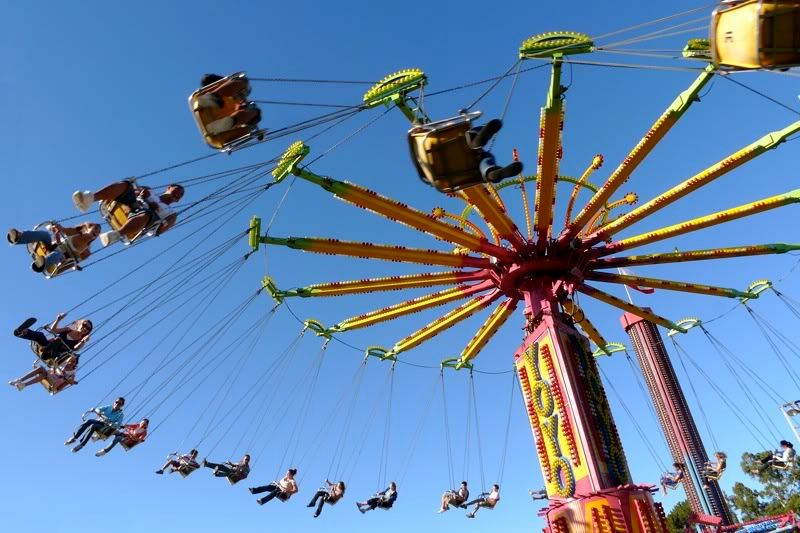
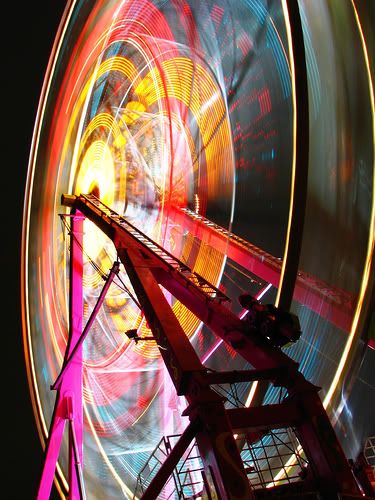
The aspects of framing and word choice that are developed through the comic work together to create the representation of time progression. This is central to the argument that the relationship between the images and words creates. Time progression is most obviously displayed in the comic in the motion that is present in the photograph. The photograph seems to be taken by a person who is riding the carnival ride. The lights on the other ride carts and on the center spindle are clear and easily distinguished while the lights that are of a different ride are blurry and are the point of reference that tells the observer that the perspective is moving. This motion is continuous across the comic due to the framing of the photograph. Although each panel is separated, the reader is able to tell that the photograph continues on behind the separation. Likewise, the flow of the words, while processed individually and then as a whole by the reader, enhances the feeling of continuation and progression beyond the white space of separation.
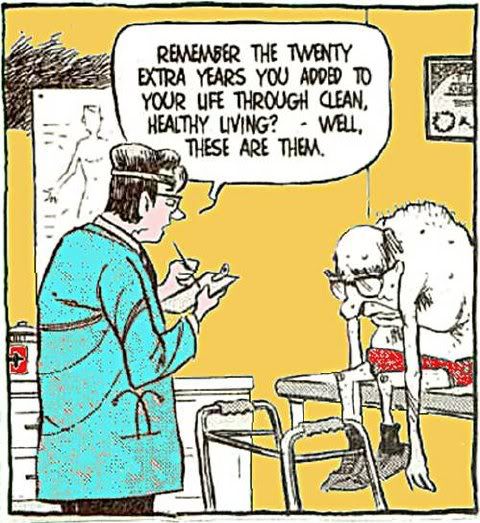
The relationship of the image and the words in this comic is the most important feature that pushes the argument developed by the technical aspect of framing, the rhetorical aspect of logos through word choice, and the element of time progression that is enhanced by these aspects and the aspect of motion. The comic argues that life ends in the same place no matter how one gets there and it is therefore meant to be taken pleasure from. The pairing of the carnival ride image is part of the argument that evokes a more specific feeling of what ‘unclean’ living can be. While it is impossible to constantly live one’s life in a carnival, the comic makes the reader reevaluate how unsoiled they live their life and brings about the question, why do I consider certain things to be important and serious to me if I am just going to die sometime anyways?

Works Cited:

Michael Baers "Traveling Carnivals". St. James Encyclopedia of Pop Culture. FindArticles.com. 21 Mar, 2010. http://findarticles.com/p/articles/mi_g1epc/is_tov/ai_2419101246/

Stan Barker "Amusement Parks". Encyclopedia of Chicago. Encyclopedia.ChicagoHistory.org. 21 Mar, 2010. http://www.encyclopedia.chicagohistory.org/pages/48.html

Monday, March 29, 2010

WP2: Rough Draft 1


Traveling carnivals are a part of an American summer tradition that many people are familiar with. The modern carnival has undergone evolutions and transformations since the debut of the amusement park at the Chicago World’s Fair of 1893 (Amusement Parks). The first traveling carnivals developed a bad reputation because of the shady nature of many of their workers, the exhibits themselves, and the nature of society at the time to judge what was not up to certain standards (Traveling Carnivals). However, after the first Chicago World's Fair that introduced amusement park rides, carnivals began to change. They started to drop the less delightful aspects of freak shows and other adverse exhibits and added more fun rides from the amusement parks. This has developed to the common traveling carnival of today that evokes the feeling of letting go and enjoying the moment with adrenaline-rush inducing rides, deep fried food and arcade games that have a limited chance of winning but you do it anyways.

The comic above uses this image of a carnival ride that represents this feeling of simply having fun. It is called “I’ve been waiting” and is a part of the “A Softer World” collection that is designed and produced by Emily Horne and Joey Comeau. The comic is comprised of three panels that are in the style of a triptych which means the background image is continuous across the separation of the three panels. The photograph is taken from the perspective of someone that is on the ride which is evident by the aspect of the motion of the carts of the ride with the background lights as a point of reference. Each panel contains writing in the form of text with a white background that is split up across the panels. The typography of the text is that of a typewriter and is very simple. The statement that the comic is making is “clean living is no fun and you wind up feeling stupid when you still die” and it is split up across the panels.

The comic’s most important aspect is the relationship that develops between the image that provides the background of the comic and the words. It uses this effectiveness of combining images and words to communicate with pathos through logos that no matter what life ends in death so one should not worry about living ‘cleanly.’ The pairing of this with the image of a carnival, where the whole point is to have fun and not care about the supposed cleanliness of what you’re doing, enhances this message. The element of time progression that is present in the comic is the most important aspect of the relationship between the words and the image. This is shown in the motion of the photograph, the framing of the photograph that makes up the three panels, and the separation of the statements in accordance with the photograph panels.

The most obvious evidence of a progression of time in the comic is the motion that is present in the photograph. The photograph seems to be taken by a person who is riding the carnival ride while the ride is in motion. The lights on the other ride carts in the first and second panels and on the center spindle that is in the third panel are clear and easily distinguished as what they are which tells the observer what the ride looks like. On the other hand, the lights that seem to be of a different ride are blurry and are the point of reference that tells the observer that the perspective is moving.

The framing of the photograph also establishes a feeling of time progression because of the continuance of the photograph beyond the separation of the panels. Each panel at first looks like individual photographs that have been left in an almost unfinished process of their development. However the panels are close enough together to recognize that each panel is just part of a whole. When observing the comic, one takes in each panel at a time during the process of reading it but then takes it in as a whole at the end. In the first panel, two carts are visible and give the first indication that the picture is of a carnival ride which represents something fun. The second panel shows a cart that is partially covered up by the words in the panel and not much else is present in the photograph. This brings the focus on the words in that particular panel. The third panel only shows the center spindle of the ride that contains bright lights that may also represent this aspect of the fun carnival. This also brings focus on the final words of the comic.

In accordance with this separation of the photograph that contains certain representations for each panel, there is a separation of the words across the comic. As with the aspect of observing each panel separately, the observer of the comic also reads each statement on its own and processes it that way, and then evaluates the entire sentence at the end. The first panel contains the statement “clean living is less fun” that is itself split in half with the first half at the top of the panel and the second half at the bottom of the panel. The pairing of this statement with the image of the two ride carts that are in the panel is what primes the reader of the comic to this notion of having fun.

..........

Works Cited:

Michael Baers "Traveling Carnivals". St. James Encyclopedia of Pop Culture. FindArticles.com. 21 Mar, 2010. http://findarticles.com/p/articles/mi_g1epc/is_tov/ai_2419101246/

Stan Barker "Amusement Parks". Encyclopedia of Chicago. Encyclopedia.ChicagoHistory.org. 21 Mar, 2010. http://www.encyclopedia.chicagohistory.org/pages/48.html
Saturday, March 27, 2010

WP2: Statement of Purpose


This writing project takes another common form of communication in the world today of cartoons and comic strips. The comic strip that I have chosen is a selection from the “A Softer World” collection. It is called “I’ve been waiting” and was put together by Emily Horne and Joey Comeau. This comic contains several elements that I want to discuss that develop the argument of the photograph through logos.

The most important aspect of this comic is the relationship between the photograph that comprises the background of each three panels and the words that appear throughout them. This relationship is developed in a chronological progression because of the fact that the entire comic is the photograph that itself is just of one moment in time. This is also provided by the motion seen in the photograph that relates to the progression of time referred to in the words. In the words themselves is the aspect of word play that matches up with what is depicted in the photo. The arrangement of the words throughout the comic also develops logos because of the effect it has on the reader to read each statement and process it and then move on to the next panel. I also want to discuss the meaning of the words themselves and how the tone and specific word choice are also forms of logos working in this comic.

This writing project would be very hard to do without the comic that I am discussing being able to be viewed by the reader of my writing. This is made possible through the context in which I am writing which is a blog. The internet helps this tremendously due to the fact that I can post hyperlinks that will lead the reader to information that can further my statements without explanation that may not be exactly pertinent to the writing. Also, I can include other images that will literally illustrate an aspect of the comic I am referring to or to just provide more visual aid to the reader.

The reader of my writing project will primarily be the teacher of the course, even though I am not directly addressing him obviously. I will be working to fulfill the expectations of this writing project that include a word count minimum and maximum, number of provided hyperlinks and multimedia elements, and other technical aspects. I will also be working to fulfill the need of the writing project in terms of actually creating something that accurately communicates what I wish to and that the 151H course requires. Secondary audiences include other members of my 151H course now and those who have previously taken it. Also, because my post is on the Internet, my blog is open for anyone to read that happens upon it. I wish to best communicate to all of these audiences.

This writing project has taken me farther into the world of rhetorical analysis through the analysis of comics, which I have not looked at in the same way as is necessary for this project. I aim to best communicate the argument that I have found that the comic makes through the aspect of logos that is most importantly ascribed in the relationship of the words and photograph that are the comic.


Monday, March 22, 2010

WP2: Pre-writing 2

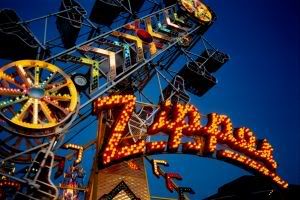
A well-know American tradition is the traveling carnival that passes through towns in the late summer, setting up stands for food, booths of arcade games, and sometimes larger rides like Ferris wheels, the Zipper, and the Octopus. These types of carnivals seem to be combining with theme parks and have evolved from what carnivals were thought to be when they first began traveling the U.S. in the 19th century, where “entertainment in rural America consisted of traveling circuses and burlesque troops, vaudeville and magic-lantern shows, all traversing the country by train or horse-and-buggy, offering temporary relief from the boredom of country life” (Traveling Circuses).

These types of traveling carnivals often featured performance by those with odd talents like sword-swallowing and ‘freak’ shows that put the strange and weird on display for the public. The people who signed up for these types of profession were not always the most quality or honest people and were often avoiding the law or had some other reason to not stay in one place. The combination of bizarre exhibits, strange people, and the supposed attitude of ‘anything goes’ created a reputation for the carnivals of a dirty, dangerous, and deceitful place of low morality. However, they still attracted crowds of people wherever they went, which proved it was still entertainment.

As the century turned, similar sorts of gathering of rides and exhibits were developing in what was known as amusement parks. The first of these appeared in Chicago in the 1890s, which was modeled after a mini-amusement park at the World’s Colombian Exposition, otherwise known as the Chicago World’s Fair (Amusement Parks). These types of gatherings were more geared to families and featured rides and booths for winning prizes and such, like Ferris wheels.

More recently, the carnivals that we see traveling the roads of America are more of a combination of the early carnivals and the later amusement parks. Magic shows are still common at these events but the country now frowns upon ‘freak’ shows; not because it is not what the wealthy people do but because it is immoral and against human rights. Now, carnivals are about the experience of adrenaline when riding on rides or winning a giant stuffed animal. They are about eating fried foods that you wouldn’t normally eat but you don’t care because it’s fun. These traveling carnivals are still not the cleanest places and the rides may not always be up to regulations but the people who attend these do not care very much about it.

The historical and cultural context of the background photo is important to the meaning of the comic because other than the words, that is all the observer has to interpret and ponder on. The reputation of carnivals as a place of entertainment and enjoyment outweighs the fact-to most people-that they are traveling sets of equipment that are not clean and the lifestyle brought about by gambling and eating fried foods is not optimal. The words of the comic are stating this but applying it in ‘grand scheme of things’ perspective: that you miss out on fun when you attempt to live cleanly and that you will end up in the same place anyway.

Works Cited:

Michael Baers "Traveling Carnivals". St. James Encyclopedia of Pop Culture. FindArticles.com. 21 Mar, 2010. http://findarticles.com/p/articles/mi_g1epc/is_tov/ai_2419101246/

Stan Barker "Amusement Parks". Encyclopedia of Chicago. Encyclopedia.ChicagoHistory.org. 21 Mar, 2010. http://www.encyclopedia.chicagohistory.org/pages/48.html

Wednesday, March 10, 2010

WP2: Pre-writing 1


(I'm having trouble figuring out how to get the image to the correct size, I've resized it in Photobucket but it doesn't seem to change the size of the photo once I upload it to the blog)

The image I have selected as a comic is called "I've been waiting" and is part of the A Softer World collection of images that are essentially photographs with typed writing somewhere over the photograph that are to be taken as a type of comic. The comics are designed by two people, Emily Horne and Joey Comeau, who work together to create comics that deliver many types of messages.

“I’ve been waiting” is comprised of three separate panels but is different from most comics because the background is all part of the same picture and is simply broken up by the space that is put between the three different frames. In paintings, this separating of a continuous image by framing or other separation is called a triptych, which I learned when analyzing a painting in the Slobodkina exhibit in the beginning of the semester. The background picture in this case is of a carnival ride in motion at night. It seems to me to be one of those rides that swing small carts of one or two people around, getting them higher and further away from the center as the ride goes faster. This kind of ride is called the Yo Yo. In the first panel, the type states “clean living is less fun” which is visually divided by two of the carts on the ride. The middle panel contains type that continues on with “and you wind up feeling stupid” in the middle of the panel. The last panel states “when you still die” in the lower half and the top half shows the middle lit-up framework of the ride.

As there are no people or characters in the comic, there is no interpersonal dialogue or interactions. However, the captions in each panel are to me a sort of dialogue between this somehow knowledgeable comic and the person who is reading the comic. One could perhaps assume the captions are the thoughts of someone who is riding the carnival ride but that was not my first impression.

The fact that there are no people to do the speaking of the text that appears in the comic is one of the ways that the “A Softer World” defies conventions that most comics follow. There is no introduction or storyline that all the comics follow specifically. This comic specifically is just stating some kind of observation about life with the goal of communicating this to someone else, but this person who is saying it is not known. Also, all of the type that is in each panel is part of the same sentence that just continues over the panels. This is not typical of a comic that has set speech bubbles (or some other sort of mode of separating text from the scene) because these usually have a continuing conversation but are logically organized into separate sentences.

The typography of the piece is very simple and is black writing with a small strip of white background in order to be able to actually see the writing on the background. The type reminds me of that of a typewriter and offers a simplicity that to me is indicative that all that is important is what the writing is saying, not what the writing looks like.